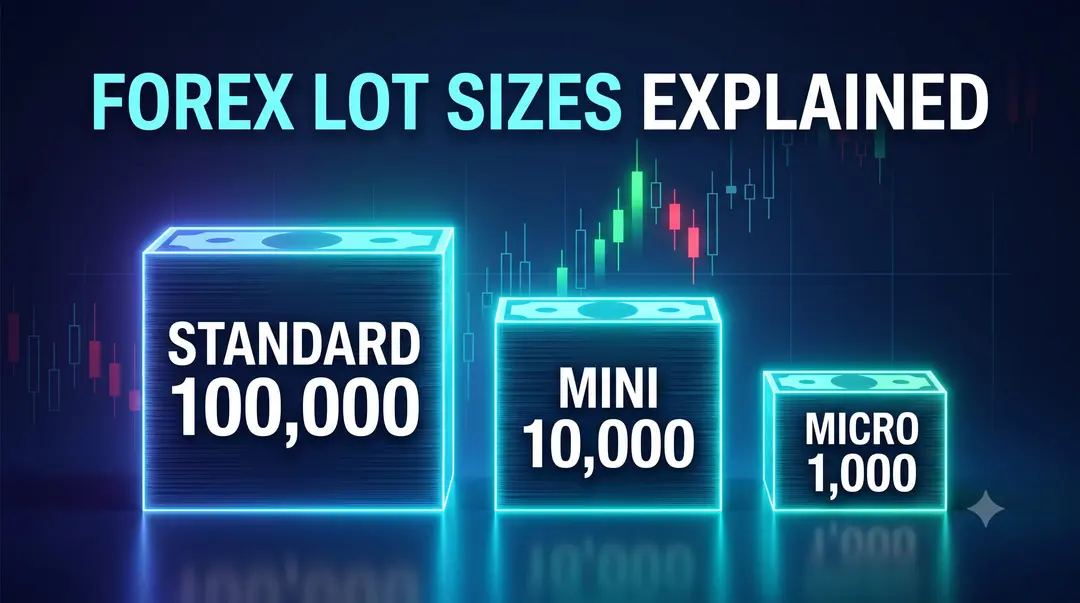
At most MetaTrader brokers, OANDA and Pepperstone included, the smallest order is 0.01. On a balance of a few hundred dollars that minimum decides what a stop 20 pips away costs you, and your 1% rule has to fit around it.
- A standard lot is 100,000 units of the first currency in the pair; 0.1 is 10,000 and 0.01 is 1,000.
- On 8 October 2026 a one-pip move on the minimum order was worth $0.10 on EURUSD, $0.063 on USDJPY, $0.120 on USDCHF and $0.132 on EURGBP.
- To keep that minimum inside 1% with a stop of 20 pips you needed $200 on EURUSD, but $264 on EURGBP.
- OANDA’s own platform takes orders from 1 unit; its MT4 and MT5 accounts, like Pepperstone’s, start at 0.01.
A $100 account risking 1% on a 20-pip EURUSD stop needs a position of 0.005 lot, and at most MetaTrader brokers the smallest order is 0.01, so the real risk is 2%. Lot size in forex is the number of currency units in your trade: a standard lot is 100,000 units, 0.1 is 10,000 and 0.01 is 1,000, which pays $0.10 per pip on EURUSD. You have the chart open, the stop-loss already sits under the last low, and the calculator says 0.005. The volume box says 0.01 and won’t take less.
So you click anyway. One stopped trade costs $2 instead of $1, and it doesn’t feel like much. Then you lose five in a row, and the account is down about 10%, not 5%.
The same order and the same 20 pips cost $1.26 on USDJPY and $2.64 on EURGBP. Why would a euro-pound trade need more than twice the account of a dollar-yen trade, when the size is identical?
How much is 0.01 lot in dollars?
On any pair where the dollar is the second currency (EURUSD, GBPUSD, AUDUSD), the minimum order pays $0.10 a pip at any price. On the other pairs it depends on the exchange rate.
We took the European Central Bank euro reference rates for 8 October 2026, worked out the dollar crosses from them and converted one pip into dollars for each size on a USD account:
| Pair | 0.01 (1,000 units) | 1.00 (100,000 units) | Loss at 20 pips on 0.01 |
|---|---|---|---|
| EURUSD | $0.100 | $10.00 | $2.00 |
| USDJPY | $0.063 | $6.32 | $1.26 |
| USDCHF | $0.120 | $11.99 | $2.40 |
| EURGBP | $0.132 | $13.21 | $2.64 |
Source: ECB euro reference rates, 8 October 2026; calculation by VipTools.
Look at the USDJPY row. One broker guide we read still gives $0.10 for USDJPY at this size, and on 8 October the real figure was 37% lower. On a $100 account and 20 pips that’s the difference between thinking you risk 2% and actually risking 1.26%. The mistake runs the other way on EURGBP, where you risk more than the old $0.10 suggests.
You can check any pair at today’s price in our pip calculator before you trade it.
What happens when the formula says less than 0.01 lot?
You can’t place it. The platform won’t accept a volume below the broker’s minimum, so you either trade 0.01 and take the bigger risk or you don’t trade. The formula itself is short:
Here it is on three small accounts, all at 1% risk and a stop of 20 pips. Where the answer falls between two steps of 0.01, we round down; where it’s under 0.01, the only order left is 0.01:
| Account | Pair | Formula says | You trade | Loss at stop | Real risk |
|---|---|---|---|---|---|
| $100 | EURUSD | 0.0050 | 0.01 | $2.00 | 2.0% |
| $100 | USDJPY | 0.0079 | 0.01 | $1.26 | 1.3% |
| $100 | EURGBP | 0.0038 | 0.01 | $2.64 | 2.6% |
| $250 | EURUSD | 0.0125 | 0.01 | $2.00 | 0.8% |
| $250 | EURGBP | 0.0095 | 0.01 | $2.64 | 1.1% |
| $500 | USDJPY | 0.0396 | 0.03 | $3.79 | 0.8% |
Look at the $250 rows. On EURUSD the step leaves you under your 1%, on EURGBP it pushes you over, with the same balance and the same rule. It’s like a shop that sells eggs only by the dozen: if you need four, you buy twelve or go home with none.
On 1,000 units each pip is worth 1,000 times the price step, but it’s paid in the second currency of the pair. On EURGBP that’s 0.1 pound, and on 8 October a pound cost $1.32. On USDJPY it’s 10 yen, and with 158 yen to the dollar that’s six cents.
You probably assumed every pair pays a dime a pip at this size; on EURGBP that day it paid $0.132.
Where does the formula trip up on a small account?
- The step. Lots move in steps of 0.01, so the formula can’t hit 1% when the answer falls between two of them, and below 0.01 it can only go up.
- The conversion. The dollar value of a pip changes with the pair and with the exchange rate, so last year’s table gives wrong numbers this year.
- The spread. The gap between the buy and sell price is paid on top of your stop. A 1-pip spread adds 5% to a stop of 20 pips.
How much money do you need to trade 0.01 lot?
For 1% on 20 pips you need $200 on EURUSD, and on other pairs the figure moves with the exchange rate. We ran the same sum on monthly averages of ECB rates since January 2010:
The dashed line is EURUSD, flat at $200, because the dollar pays its own pip. The others wander. On 28 October 2011, with the dollar at 75.77 yen by ECB rates, a dollar-yen trade needed $264 of balance. On 28 July 2026 the dollar-yen rate worked out from ECB figures reached 163.91, the highest in that series back to 1999, and the same order needed only $122. These are daily reference rates taken at 14:15 Frankfurt time, not the high of the day on the market, so your broker’s quotes that day could have gone further.
Have you checked whether your last stop came from the chart, or from what the minimum order could afford?
Because that’s the trap. When the minimum size is too big, it’s tempting to pull the stop closer until the loss fits 1%. On $100 and EURUSD, a stop at 10 pips gives you $1 before the spread. The sum works. The trade changes: the stop sat under the last low for a reason, and at 10 pips it no longer sits there.
We think the answer is simple. If 0.01 breaks your risk limit, skip the trade, or take the same idea on a pair where the pip is cheaper. Don’t shrink the stop to fit the order size.
“I mean I always trade micro lot 0.01 0.02 sizes never more than 0.1 for me”
ScottHughes, Babypips forum, 9 January 2020
That’s a sensible habit, and the guides at the top of the search results say the same: start with micro lots. We’d add the line they leave out. On a $100 account, 0.01 on EURUSD is 2% at 20 pips and 4% at 40.
Can you trade less than 0.01 lot?
Yes, but usually not in MetaTrader. OANDA’s help pages list the minimum on its own platform as 1 unit (0.00001 in MetaTrader terms), while its MT4 and MT5 accounts start at 0.01. Pepperstone lists 0.01 as the minimum on all its accounts.
OANDA’s own platform trades in units, not lots. You type the number of units, so a $100 account can open 500 units of EURUSD and lose $1 at 20 pips before the spread. Source: OANDA help centre, minimum trade size and micro lots pages, checked October 2026.
Some brokers also offer “nano” lots of 100 units or cent accounts, where the balance is counted in cents. We did not go through every broker’s specification sheet, so before you open one, find two lines in its contract specs: the minimum volume and the volume step. On a small balance those two numbers decide whether 1% is possible at all.
Before you place the order:
- Put balance, risk and stop into the lot size calculator.
- If the answer is under 0.01, look at what one pip on that pair costs in dollars, not at the size.
- If no pair fits, write the idea down and wait for a bigger balance or a smaller step.
What is lot size in forex: standard, mini and micro
A lot is a packet of the first currency in the pair. On EURUSD a standard one means 100,000 euros, and each pip is worth $10. A mini (0.1) earns a tenth of that and a micro (0.01) a hundredth, $0.10, again only on pairs that end in USD.
MetaTrader shows the size as a decimal, so you’ll type 1, 0.1, 0.03 or 0.01, never the word “mini”. Leverage only changes how much of your money the broker holds aside as margin while the trade is open. It doesn’t change what each move of that packet is worth.
So back to the volume box. It shows 0.01, and on a $100 account and a stop of 20 pips that’s $2 on EURUSD and $2.64 on EURGBP.
Size your next trade
Account, risk and stop in, position size out. Free, in your browser, no sign-up.